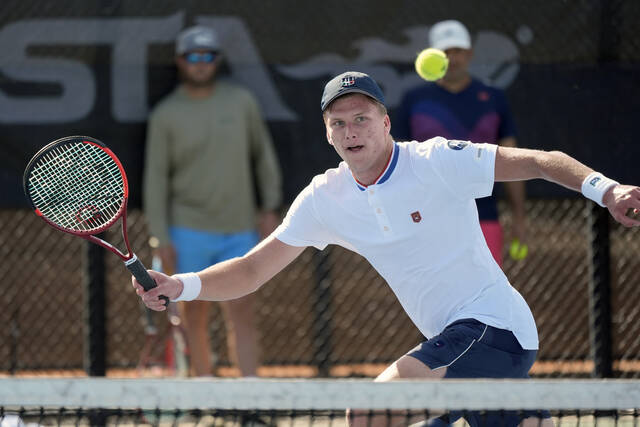


ORLANDO, Fla. — Jenson Brooksby tugged at the right shoulder of his red T-shirt and fiddled with some strands of his dirty blond hair as he spoke to the Associated Press about what he’d like the world — the tennis world, yes, but also everyone else — to know about him.
Once a member of an up-and-coming group of American men making their mark with big wins at Grand Slam tournaments, Brooksby wants folks to be aware of what went on while he was away from the tour for nearly two “frustrating” years that, he said, made it “easy to get depressed.” Ranked No. 33 at age 21 in 2022, just a year after going pro, he’s now unranked after being sidelined by injuries, operations and a ban connected to missed drug tests that eventually was reduced.
And, as Brooksby prepares to compete again in January, including at the Australian Open, he wants people — other players, yes, but also anyone else, including those who are, or know someone who is, autistic — to hear about his experience living with autism spectrum disorder, which he discussed publicly for the first time during a recent interview.
“It’s … just something I don’t want to have to keep to myself,” Brooksby said over a post-workout lunch in a boardroom at the U.S. Tennis Association National Campus. About 20 miles east of Walt Disney World, it’s the site of preseason training for about a dozen tennis pros.
“It’s obviously a personal topic that, even with people you may feel very comfortable with — in my mind, at least for a long time — it wasn’t (something) to just go blurting out as part of a conversation, you know?” said Brooksby, 24, a native Californian who said he was nonverbal until the age of 4. “But I’ve always thought about it and … I, eventually, just wanted to talk about it.”
As a kid, he said, he spent about 40 hours a week with therapists “to be able to even just start talking … (and) then to get better at communication and social situations.”
There are no blood or biological tests for autism, a developmental disability caused by differences in the brain identified by observing a child’s behavior. Formerly only diagnosed in children with severe language difficulties, social impairments and unusual repetitive behaviors, autism is now defined in a broader way and used to describe a group of milder, related conditions, too.
Brooksby called the autism a “big strength” in “pressure moments” on court, allowing him to “focus on two or three specific details really well for a long period of time.” He also mentioned “something that makes (tennis) a little tougher”: He will have outbursts if he’s losing or if he is upset about a certain shot or aspect of his technique, a tendency his athletic trainer, Paul Kinney, keeps an eye out for, along with signs of discomfort such as reaching for his clothing or hair or leaning forward with hands on knees.
Brooksby, who “presented as a very severe case” as a child, now “is on the very mild end of the spectrum,” according to Michelle Wagner, a board-certified behavior analyst whose area of specialty is autism spectrum disorders. She said she first began working with Brooksby when he was 2 years, 9 months and had been diagnosed by others; the progress he made, Wagner said, is an “unusual and unique outcome.”
Brooksby was given what at first was an 18-month suspension by the International Tennis Integrity Agency (ITIA) in October 2023.
He was not accused of testing positive for a banned substance but, instead, of failing to show up for three drug tests within a 12-month period; according to the ITIA’s initial report, his side argued that miscommunication with a doping control officer trying to find him at a hotel in the Netherlands “was not due to any negligence on (the player’s) part.”
Brooksby appealed, and he and the ITIA agreed to a reduced punishment, making him eligible to return in March 2024 instead of January 2025. The ITIA said his “degree of fault … should be reassessed” due to “new information relating to the circumstances giving rise to the missed tests.” The ITIA never announced what that new information was; a spokesman declined to comment on the case Wednesday.
Brooksby has been off the tennis tour for almost two full years, but he plans to return on the lower-level Challenger Tour in Canberra, Australia, next month, before heading to the Australian Open, which begins Jan. 12. It was there, in January 2023, that Brooksby upset three-time Grand Slam runner-up Casper Ruud. Two days later, Brooksby lost to eventual semifinalist Tommy Paul.
That’s where the “Activity” section of Brooksby’s ATP Tour record ends. First came surgery on his left wrist that March. Then surgery on his right wrist in May. Then the ban.
“Multiple bad things just happened at once,” he said. “It was a lot to take, mentally.”
After the suspension, Brooksby didn’t play right away, partly because of shoulder pain when he resumed hitting and partly because he was assembling a new team (he now is with coaches Eric Nunez and Rhyne Williams, along with Kinney, who previously was with him in 2022).
Kinney said Brooksby has trained to improve his body, including his posture, and parts of his game, including his serve.
“Try to become better,” Brooksby said. “That’s the goal.”