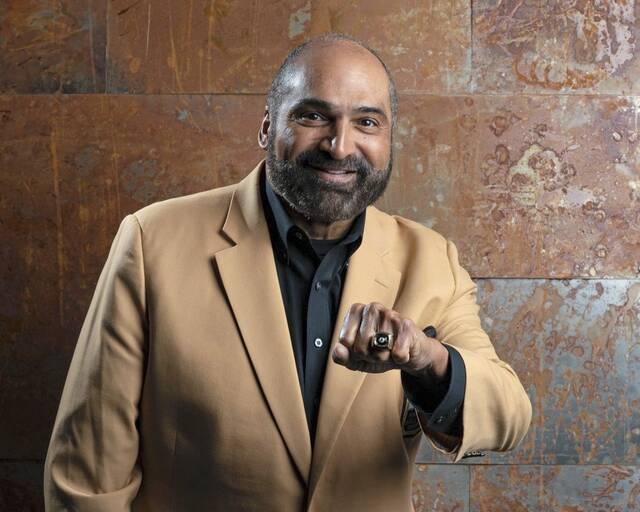
On Dec. 23, 1972 — 53 years ago — Pittsburgh Steelers running back Franco Harris made National Football League history with the Immaculate Reception.
The Senator John Heinz History Center is celebrating the football legend by changing the Western Pennsylvania Sports Museum to the Franco Harris Sports Museum in 2026.
At an announcement event at the Heinz History Center on Tuesday, Ann Madarasz, the History Center’s chief historian and director of the Sports Museum, joked that she’s going to need a new name tag.
“I’m now the director of the Franco Harris Sports Museum. I can’t tell you how much that means to me, and what it means to all of us here, to have his name forever associated with this institution,” she said.
Madarasz talked about how hard Harris worked to build the Sports Museum, about their decades of working together and Harris’s selflessness and graciousness.
Harris died on Dec. 20, 2022, just days before the Pittsburgh Steelers were set to celebrate the 50th anniversary of the Immaculate Reception.
“He was more than just a Hall of Fame player; he was a Hall of Fame person. Never satisfied to do anything halfway, he filled his life with acts of purpose,” Madarasz said. “I understand it drove his teammates crazy.”
Other speakers included Pennsylvania State Senators Kim Ward and Wayne Fontana, and everyone had stories about Harris’s kindness and generosity.
Harris played football at Penn State University before being drafted 13th overall by the Steelers in 1972. He won four Super Bowls with the Steelers and was inducted into the Pro Football Hall of Fame in 1990.
He was a longtime supporter of the Heinz History Center and was pivotal in the development of the Sports Museum, which opened in 2004. Harris served as the Museum’s first chairman. He was also passionately involved with causes in the region, including the Pittsburgh Promise, the United Way, Special Olympics of Pennsylvania, Habitat for Humanity and a number of other initiatives.
“He embraced causes of social justice and equality and strived to deliver on that promise and ensure that everyone — children with disabilities, people of color, girls and women with a passion for football, veterans and city kids who yearned for a college education — had a chance to achieve their dreams,” Madarasz said.
The late Harris’s wife, Dana, is a member of the History Center’s Board of Trustees and the Sports Museum’s Champions Committee, and his son, Dok, is a co-chair of the History Uncorked event committee.
Dana Harris thanked the Heinz History Center for “an incredible honor for an incredible man.”
“The Heinz History Center always strives to be the best,” she said. “The best is what Franco and his teammates always gave to Pittsburgh. Kindness, integrity, decency are all words used to describe Franco. … and I’d like to add two things to that: respect and love.
“He found beauty in every day. He started every day with a smile, which still amazes me. He’s definitely smiling right now,” she added.
The two-floor Sports Museum at the Heinz History Center spans 20,000 square feet of interactive gallery space. The museum highlights Western Pennsylvania’s rich and varied history in sports from football to golf to hockey and beyond. It contains artifacts from both the region’s legendary sports stories and its hidden athletic gems, including a display on the Immaculate Reception with a life-sized figure of Harris, turf from Three Rivers Stadium and other one-of-a-kind artifacts.
The “Super Steelers” exhibit at the museum also features a section specifically on Harris, educating visitors on his life and career. It contains his four Super Bowl championship rings, his 1976 Man of the Year award and his “Franco’s Italian Army” helmet.
“He was the one who called sports champions together to create this now-nationally-known sports museum,” Andrew Masich, president and CEO of Heinz History Center, said Tuesday.
“This new phase of the museum’s life inspires us to chart a new path for the future. Franco embodied the best of what sports can be, and this naming allows us to view the museum with all the characteristics that he embodied,” Madarasz said.