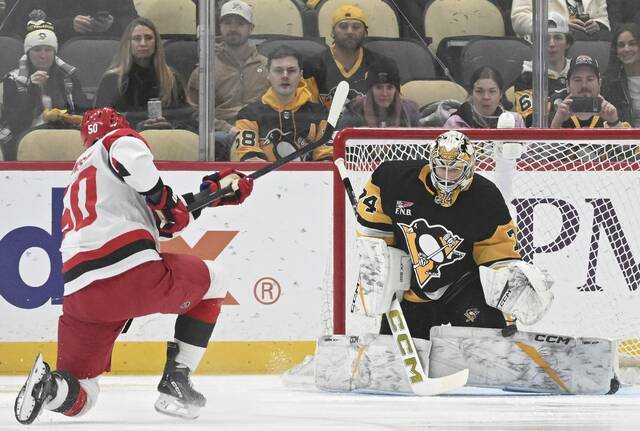
As a preteen, Stuart Skinner attended a goaltending camp in Toronto put on by youth development coach Eli Wilson.
When Skinner was traded to the Pittsburgh Penguins on Dec. 12, he thought back to that camp and two people in particular whom he crossed paths with there.
The first was Jason Spezza, then a star with the Ottawa Senators and now assistant general manager in Pittsburgh, who unsurprisingly ripped several shots past the young Skinner at the camp.
Skinner also encountered Andy Chiodo, who was in the midst of an eventual 15-year professional hockey career and now oversees Skinner as the Penguins goaltending coach.
“It’s cool now that he’s my coach,” Skinner said. “Especially at the start, he allowed me to get a couple games in just so he got a feel for how I like to play the game, and I got a feel for how he looks at it. We were really able to mesh in some good ideas.
“He’s done a fantastic job with me and has really (good) insight about the game and different things that I can do on a goaltender level and a technical/tactical point of view. He’s given me a lot of golden nuggets that I’ve taken in.”
Parallels pertaining to inconsistency existed between Skinner and Tristan Jarry, whom president of hockey operations Kyle Dubas traded to Edmonton in the December goalie swap. The Penguins also received defenseman Brett Kulak and a second-round draft pick in 2029.
The struggles of Jarry, a two-time NHL All-Star with the Penguins, were well-documented.
Skinner also absorbed his fair share of criticism before departing Edmonton, particularly over the Oilers’ back-to-back series losses to the Florida Panthers in the Stanley Cup Finals.
In last season’s Final, Skinner was pulled in the third, fourth and decisive sixth game of the series.
However, when he touched down in Pittsburgh, Skinner’s reputation had little to do with perceived postseason shortcomings.
“You don’t get to two Cups without being pretty good,” defenseman Parker Wotherspoon said. “Everyone knows he’s been a good guy around the league — solid, humble and a family man. Any time you get to two Cup Finals as a goalie, you’re pretty (expletive) good. Coming here, a little bit less media pressure and a fresh start has helped him a ton. Total confidence having him back there.”
At the Olympic break, Skinner has made 13 appearances for the Penguins, going 8-4-1 with a 2.72 goals-against average and .887 save percentage.
Over 23 starts with Edmonton pre-trade, Skinner went 11-8-4 with a 2.83 GAA and .891 save percentage.
Leaving Edmonton, where Skinner was drafted in 2017 and spent his entire NHL career until being traded, constituted a major change for him and his family.
But in Pittsburgh, things have settled down, with Skinner enjoying his new surroundings and teammates.
“I think I mesh in really well with this group,” Skinner said. “That has to do a lot with the room, not necessarily me. You can go around the room with every single guy — there’s only good people here who really care about each other. It starts with leadership and runs down the whole team. Everybody has really come together. If you come to the dressing room during a game day, a practice or whatever, it feels like a family.”
So far with the Penguins (29-15-12, 70 points), Skinner has showcased a steady presence but some shakiness as well.
As the Penguins headed into the Olympic break, it was the latter, as Skinner’s final two starts featured five goals allowed in each and a combined .766 save percentage.
But before those contests, a wild win over the Rangers and overtime loss to the Islanders, Skinner enjoyed a 7-1 stretch, stopping 183 of 196 shots for a combined .933 save percentage from Dec. 30 to Jan. 25.
Coach Dan Muse has seen fit to deploy Skinner in a platoon with Arturs Silovs, who is 11-7-8 with a 2.93 GAA and .896 save percentage.
Skinner is fine with that arrangement.
“It’s been awesome,” Skinner said. “(Silovs) and I have been able to get some really good games in, and from my point of view, why would we change a good thing? We’ve been getting some big games, some big wins out of everybody in this locker room. For me and (Silovs), I only want to see him be successful.
“I’m always going to be cheering him on no matter what. I feel the same thing from him. We have a really good dynamic. … We’re having a lot of fun out here.”
Sitting in second place in the Metropolitan Division, the Penguins find themselves in playoff position with 26 games remaining, beginning Feb. 26 at home vs. New Jersey.
But from then through April 14, tough sledding awaits. Before the end of the regular season, the Penguins play the Colorado Avalanche twice, Carolina Hurricanes three times and also face the Tampa Bay Lightning, Dallas Stars and Detroit Red Wings.
Per Tankathon, with a combined .580 opponent points percentage, the Penguins have the toughest remaining strength of schedule in the NHL.
Muse, though, is confident in his club’s goaltending.
“You saw it from the moment he got here — (Skinner is) a competitive guy. His preparation is excellent, so I think both him and (Silovs), their games continue to be in good places,” Muse said. “But they’ve worked for it, too.”