
https://triblive.com/sports/team-canada-coach-jon-cooper-offers-brief-update-on-sidney-crosby/
Sidney Crosby’s Olympic injury sparks debate over NHL player participation

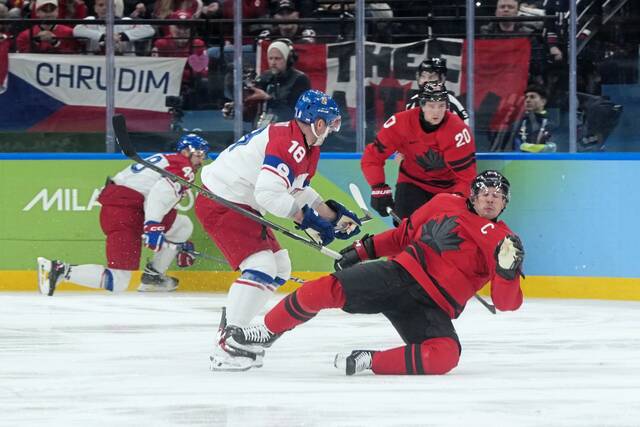
Uncertainty continues to surround the status of Pittsburgh Penguins forward Sidney Crosby, who was injured in Wednesday’s Olympic quarterfinals contest between Canada and Czechia.
Canada coach Jon Cooper provided a limited update to reporters in Milan following his team’s optional practice Thursday, in which Crosby did not partake.
“Sid is by no means ruled out of the tournament,” Cooper said. “We’ve got the best of the best looking at him. … We’re taking this day by day. And we’re not going to put anyone in harm’s way. But if he can play, he’s definitely going to. We’ll know more in 24 hours.’’
Crosby, who is Canada’s captain, absorbed an awkward hit from Czechia defenseman Radko Gudas and forward Martin Necas in the second period and left the game.
After heading to the bench and being attended to by a Hockey Canada staffer, the 38-year-old Crosby went to the locker room and did not return, with his team going on to win 4-3 in overtime.
After the Penguins’ Thursday morning practice in Cranberry, coach Dan Muse echoed the update Cooper provided.
“I got the same thing, just the update there from Team Canada this morning that went out to the public,” Muse said. “Obviously, that’s the information that we have, as well. Thinking of Sid, it’s good to hear that that’s the current status. Just continuing to think of him and (remain) hopeful.”
Given Crosby’s stature as one of the NHL’s faces for multiple decades, his injury naturally sparked debate as to whether the league should even be sending its players to participate in the Olympics.
Crosby’s longtime teammate, Penguins alternate captain and defenseman Kris Letang, said around the league, the desire among players to compete in the Olympics is intense.
“Winning the Stanley Cup is the ultimate pride of a hockey player, but the Olympics comes around once every four years,” said Letang, the Penguins’ NHLPA representative. “You don’t know how long you’re going to play in the NHL and, if those years allow you to play on the biggest stage in the world for sports, that every single country is watching — yeah, 100% those guys want to play. They should have the right to.”
For the last decade-plus, Letang and his peers have been disappointed, given that 2026 marks the first time NHL players have competed in the Olympics since 2014 in Sochi.
In 2022, the reasoning was simple enough: the 2021-22 regular season was already being disrupted because of covid-19, with the NHL and NHLPA mutually agreeing to forego Olympic participation in Beijing.
Four years earlier, however, the NHL, NHLPA, International Olympic Committee and International Ice Hockey Federation were not on the same page.
Whereas in 2022, the relevant parties had agreed upon NHL Olympic participation, the 2018 Games held in PyeongChang featured no such consensus.
When a dispute over costs associated with travel, insurance and accommodations arose, the NHL opted to end its streak of sending players to the Olympics that dated to 1998.
“This is the NHL’s decision, and its alone,” the NHLPA said as part of its statement following the NHL’s decision in April 2017. “It is very unfortunate for the game, the players and millions of loyal hockey fans.”
Insurance for its players is a matter the NHL does not take lightly.
This year, 158 NHL players are competing in the Olympics. Together, they represent approximately $3.7 billion in salaries over the lives of their contracts.
NHL deputy commissioner Bill Daly discussed several matters pertinent to insurance at the Olympics during a recent podcast appearance before providing additional context and clarification to TribLive via email.
Per Daly, “a large portion” of that $3.7 billion is already insured by the NHL, whose clubs guarantee players’ contracts and treat Olympic injuries such as Crosby’s as a “hockey-related injury.”
As a result, the remainder of their contracts are guaranteed, opposed to if a player suffered an injury in a pickup basketball game, for example.
For players whose NHL contracts are not insured, historically, the IIHF or IOC, member national associations (such as Hockey Canada) or the Olympic Games Organising Committees (such as Milano Cortina 2026) have stepped in to handle whatever remaining coverage is required.
Clarification on that matter was integral to the NHL’s participation at the 2026 Games.
Though players are certainly cognizant of larger business and liability implications, unsurprisingly, the prospect of suffering an Olympic injury does not seem to overshadow a desire to put on the sweater of one’s home country and compete in front of the world.
“There’s tons of stuff guys do during the summer where they can suffer an injury,” Letang said. “Now, hockey is a 12-month thing. Everybody skates in the summer, they train — it’s 12 months out of the year. An injury can happen at any moment. You can cross the street and get in an accident. Yes, it’s the (Olympics), but (injuries) could have happened in the season two games before. I don’t put too much thought into it.”
Note: Injured Penguins defenseman Jack St. Ivany skated before practice. According to Muse, St. Ivany has been working out on the ice for a handful of days already. There has been no change in his status. The team placed St. Ivany on injured reserve Jan. 29 following surgery on his left hand and offered a timeframe of eight weeks for recovery.
Staff writer Seth Rorabaugh and the Associated Press contributed to this report.
Copyright ©2026— Trib Total Media, LLC (TribLIVE.com)