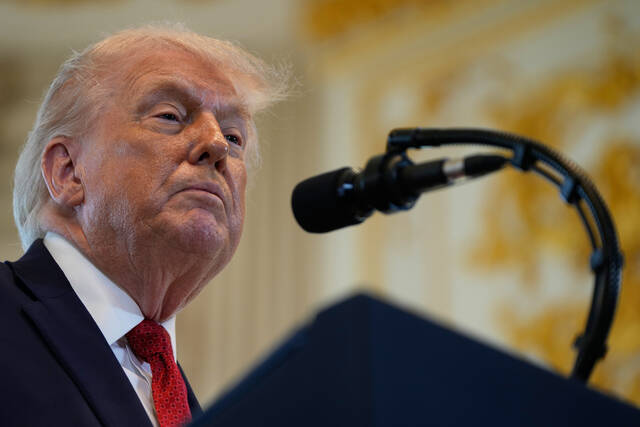
WASHINGTON — President Donald Trump said he intends to sign an executive order that would give an exclusive four-hour broadcast television window to the Army-Navy Game.
“Under my Administration, the second Saturday in December belongs to Army-Navy, and ONLY Army-Navy!” he wrote on Truth Social Saturday. “I will soon sign a Historic Executive Order securing an EXCLUSIVE 4 hour Broadcast window, so this National Event stands above Commercial Postseason Games. No other Game or Team can violate this Time Slot!!!”
The Army-Navy Game is an annual college football game between rivals the Army Black Knights, representing the U.S. Military Academy at West Point, New York, and the Navy Midshipmen of the Naval Academy in Annapolis, Maryland.
Donald J. Trump Truth Social Post 09:00 PM EST 01.17.26
— Commentary Donald J. Trump Posts From Truth Social (@TrumpDailyPosts) January 18, 2026
The Army-Navy Game is one of our Greatest American Traditions — Unmatched Patriotism, Courage, and Honor! This incredible Tradition is now at risk of being pushed aside by more College Playoff Games, and Big TV Money. NOT…
The game began as a friendly rivalry in 1890. CBS has held the exclusive rights to broadcast the game since 1996 and in December 2024, announced it had signed a 10-year extension of the deal through 2038.
Presidents frequently attend the championship. Trump attended the most recent Army-Navy Game, won by the Midshipmen, on Dec. 13 in Baltimore.
It’s not clear exactly what prompted Trump to raise the issue, how Trump intends to implement his plan or what authority he would have to do so.
“The Army-Navy Game is one of our Greatest American Traditions — Unmatched Patriotism, Courage, and Honor!” he wrote in his Truth Social post on Saturday. “This incredible Tradition is now at risk of being pushed aside by more College Playoff Games, and Big TV Money. NOT ANYMORE!”
The president has taken a keen interest in college sports since returning to office. He plans to attend the College Football Playoff National Championship Game on Monday in Miami between the Miami Hurricanes and the Indiana Hoosiers.
In July, he signed a “Saving College Sports” executive order seeking to restrict some pay-for-play arrangements to players, clarify the employment status of student athletes and protect scholarships and compensation for college sports that, unlike football, don’t generate significant revenues.
That executive order said “waves of recent litigation against collegiate athletics” were threatening the viability of college sports.
Some college football leaders have been pressing to expand the playoffs from 12 teams to 16, according to ESPN. The Sports Business Journal reported that Army and Navy administrators have held early-stage discussions about what an expanded playoff schedule could mean for their game’s December broadcast.