






Women’s college volleyball is more popular than ever and about to hit its peak.
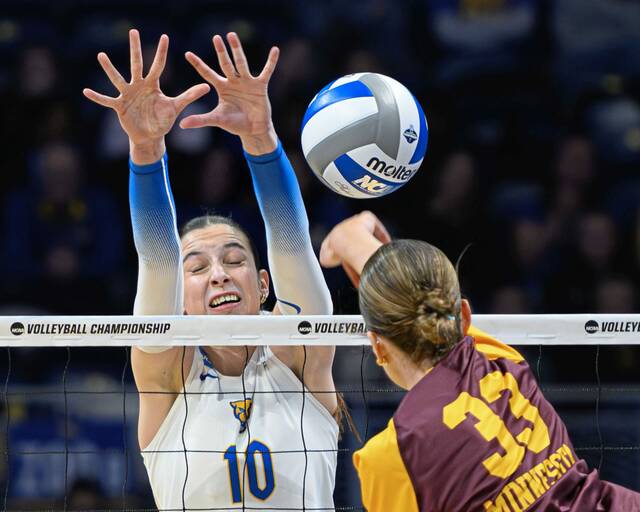
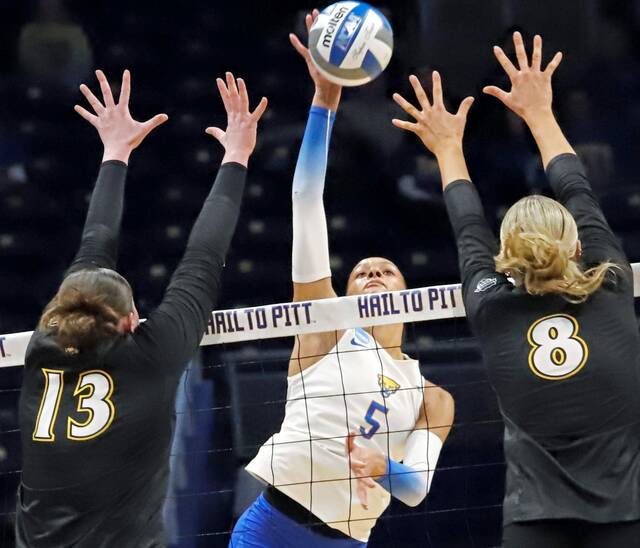
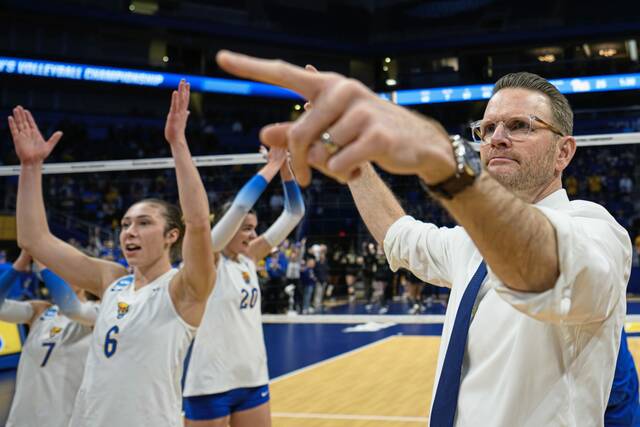
Pitt’s women’s volleyball volleyball team will play in the national semifinals for the fifth straight season Thursday night.
The Panthers are the first program to accomplish the feat since Texas did so from 2012-16.
Pitt will play Texas A&M at 6:30 p.m., with Kentucky and Wisconsin to follow shortly after at the T-Mobile Center in Kansas City.
WE'RE HEADED TO OUR FIFTH STRAIGHT NATIONAL SEMIFINAL!!! pic.twitter.com/lrFWN7B1T3
— Pitt Volleyball (@Pitt_VB) December 14, 2025
The winners will play for the NCAA championship at 3:30 p.m. Sunday.
The semifinals will be televised on ESPN, and the championship match will be on ABC.
Want to join in and see what has garnered record-setting attention nationwide?
Here’s an explainer about women’s college volleyball ahead of the NCAA semifinals:
The stars
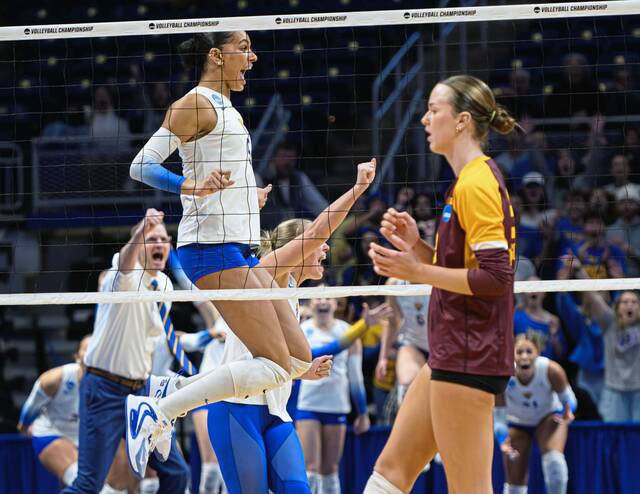
Some of the nation’s top players will be on the court Thursday, including three finalists for the AVCA National Player of the Year award.
Pitt junior right-side hitter Olivia Babcock became the first Panthers player to win the award last season and has continued her dominating play this season.
Babcock, who was the most outstanding player in the Pittsburgh Regional for a third straight year, could become the fifth player to win the award in back-to-back seasons. The other three finalists are Wisconsin’s Mimi Colyer, Kentucky’s Eva Hudson and Nebraska’s Bergen Reilly.
Babcock was also named the AVCA East Coast Region Player of the Year for the second straight year and ACC Player of the Year. She is averaging career highs of 5.11 kills per set and 2.11 digs per set.
The 2025 @AVCAVolleyball National Player of the Year Finalists ????
Olivia Babcock – @Pitt_VB
Mimi Colyer – @BadgerVB
Eva Hudson – @KentuckyVB
Bergen Reilly – @HuskerVB #NCAAWVB pic.twitter.com/wA5HL353q3— NCAA Women's Volleyball (@NCAAVolleyball) December 15, 2025
Panthers’ supporting cast
In addition to Babcock, the Panthers were represented on the Pittsburgh Regional All-Tournament team by setter Brooke Mosher and outside hitter Marina Pezelj. The three also were on the all-region team, with outside hitter Blaire Bayless and middle blockers Bre Kelley and Ryla Jones.
And Pitt coach Dan Fisher was named the AVCA East Coast Region Coach of the Year for the fourth time.
Terms and phrases
Here’s a look at some of the terms you might hear if you tune in:
Ace: A serve that is not handled by the opponent and immediately results in a point.
Assist: Passing or setting to a teammate.
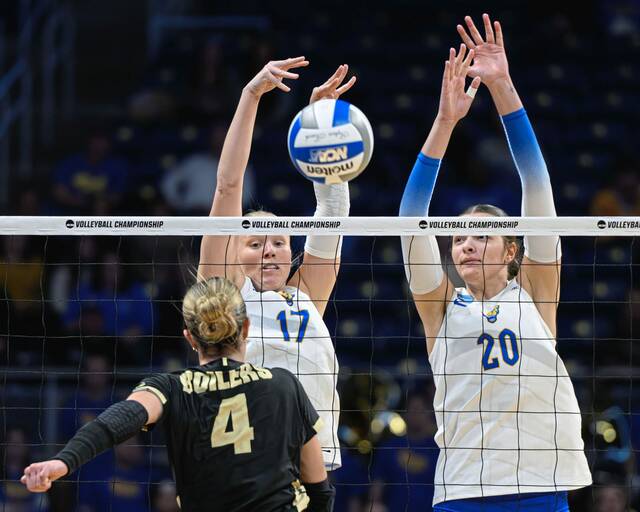
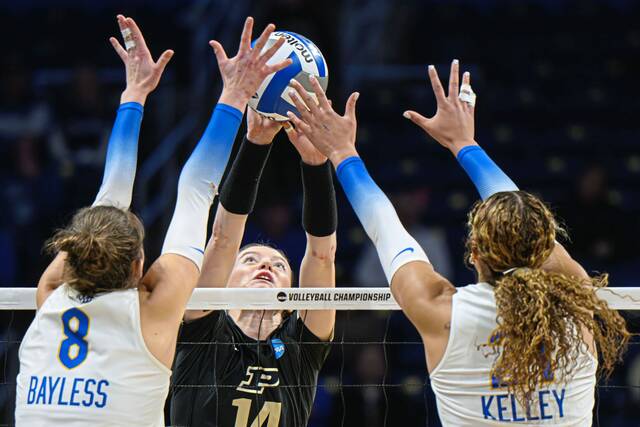
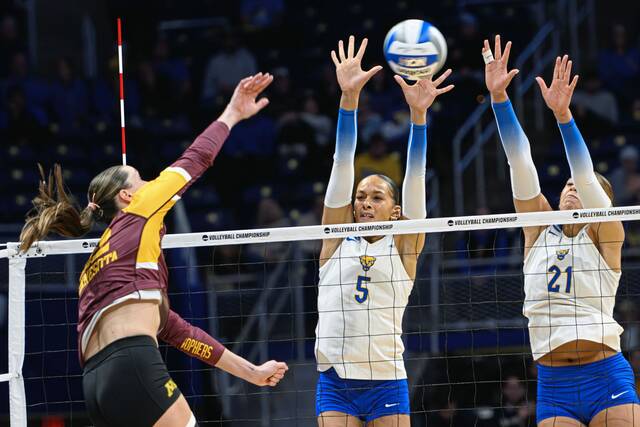
Block: When one or more players on defense deflect or spike a ball back to the hitter’s court, typically right at the net.
Dig: Passing a spiked ball that is close to the floor.
Hit/spike: When a player jumps to strike the ball with an overhand forceful shot.
Jump serve: When a server tosses the ball in the air and jumps while hitting it toward the opponents’ side.
Kill: An attack that gives a team an immediate point.
Rotation: The movement of players around the court after a point.
Set: Directing a ball to a hitter for an attack.
Side out: When the receiving team scores a point or the serving team commits an error.
Rules and regulations
• College volleyball uses a best-of-five sets format, with the team that wins three sets declared the winner. Sets are played to 25 points, but a team must win a set by a two-point margin. If a match reaches a fifth set, it is played to 15 points.
• Matches are played via rally scoring, which means a point is awarded on every service.
• Each team can only touch the ball three times on their side of the net once a ball is served, excluding a block, before it must be hit over the net to the opposing team. The ball cannot touch the floor.
• A point is scored when the serve doesn’t clear the net, a ball hits the floor, a ball is hit out of bounds or if a team hits the ball more than three times. Teams also can be awarded points if the opponent has a double hit or hits the antennas on the net or via penalties/fouls such as touching the net or carrying the ball.
What’s with the rotation?
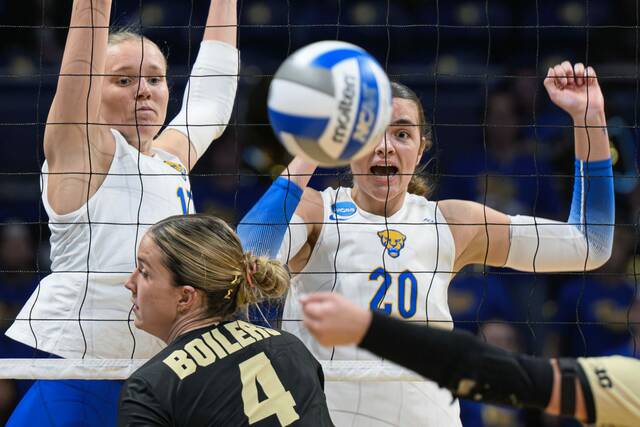
Each team plays with six players on the court — setter, middle blocker(s), outside hitter(s), opposite, libero/defensive specialist — and they rotate after a point that results in a change of serve, also known as a side out.
Players move clockwise one spot so all players rotate through the serving position.
Coaching strategy comes into play with what players are subbed in to certain places within the rotation to highlight their specialty, whether it may be serving, blocking, hitting, passing or digging.
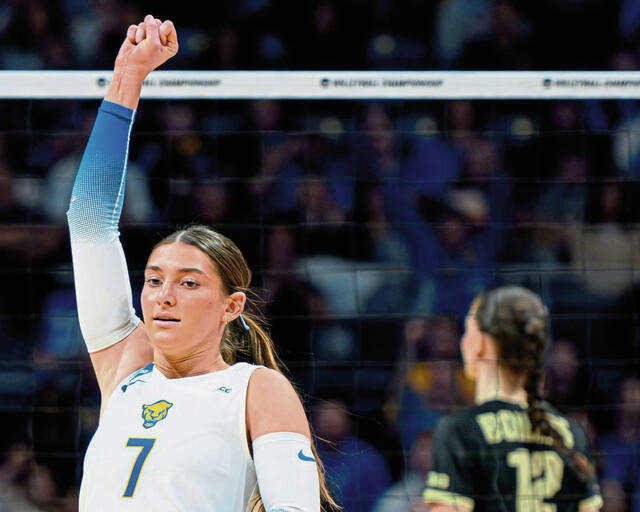
What does each player do?
Setter: Runs the team’s offense and feeds sets to the hitters. A setter needs to be a good communicator and passer who can identify weak spots in the opposing defense.
Outside hitter: A hitter that attacks from the left side and the primary offensive attacker. This player is usually relied on to receive serves and have back-row skills in addition to being the top hitter.
Middle blocker: Typically the team’s tallest players, they block the center of the net against middle attacks and slide to each side to pair with the outside and opposite hitters on blocks. They also are capable hitters offensively on quick sets.
Opposite: A hitter from the right-side, they are usually able to hit from the front or back row. They work with the middle blocker and also handle some setting when needed.
Defensive specialist: Plays in the back row, responsible for receiving serve, defensive plays and passing to the setter.
Libero: Back-row player similar to defensive specialist who wears a white jersey when her teammates wear their colored jerseys or vice versa. A libero is normally one of the team’s best passers and is restricted by rules limiting hitting, blocking and setting. The libero cannot complete an attack hit when the ball is above the net and cannot perform an overhead set in front of the attack line (10-foot line). They are essentially, at times, limited to where they can play balls on the court. The libero also can only be replaced in the rotation by the same player she has replaced. Coaches commonly sub in a libero for a middle blocker when the middle blocker rotates to the back row.
Fired up
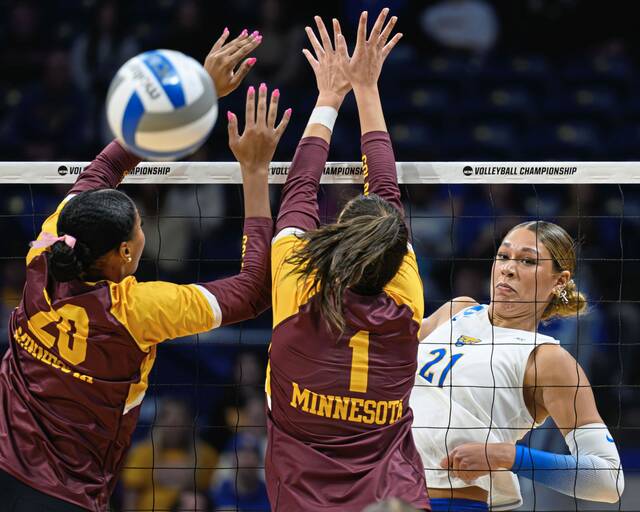
Being in a gym during a college volleyball match can be compared to sitting next to a speaker during a rock concert or being on a airport runway during takeoff.
Cheering is as much a part of the game as hitting, blocking and setting.
The players get together after each point for a quick huddle and cheer or chant.
Those celebrations can help maintain momentum or keep the crowd energized.
let the good times roll ???? pic.twitter.com/Tl9auwrgRn
— Pitt Volleyball (@Pitt_VB) December 14, 2025
Title towns
Stanford remains the standard bearer for NCAA women’s volleyball. The Cardinal have won nine NCAA championships, in addition to eight runner-up finishes.
Penn State is the reigning champion, after beating Louisville to claim its eighth title in 2024.
5TH STRAIGHT NATIONAL SEMIFINAL APPEARANCE FOR PITT ????#NCAAWVB x ???? ESPN2 / @Pitt_VB pic.twitter.com/MP4QvHNOkM
— NCAA Women's Volleyball (@NCAAVolleyball) December 14, 2025
Other programs to claim NCAA titles include:
Nebraska, 5
UCLA, 4
Hawaii, 3
Long Beach State, 3
Texas, 3
USC, 3
Pacific, 2
Kentucky, 1
Washington, 1
Wisconsin, 1