

Editor’s note: ‘What’s That?’ is a recurring feature in the Tribune-Review’s Westmoreland Plus edition. If there’s something you’d like to see explored here, send an email to gtrcity@triblive.com or call 724-838-5146.
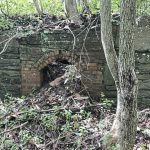
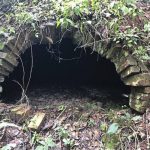
Hidden by woods and dense undergrowth just off Brush Creek in North Huntingdon, amidst tires and other trash people dumped off Route 993, is a cluster of at least a dozen bricked structures that date to the time when Westmoreland County was a coal-and-coke producing region.
The red-brick Larimer Coke Ovens in Ardara, now in various states of disrepair and deterioration, are losing the battle against overgrowth. Rounded entrances are missing some bricks, dirt fills some of the openings and the tops of the ovens have become home to trees.
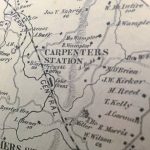
The coke ovens were noted in the “Historical Atlas of Westmoreland, Pa., Illustrated, 1876,” between Carpenter’s Station and Larimer’s Station, bounded by Brush Creek and just off the Pennsylvania Railroad line linking the county to Pittsburgh.
The coke works contain two batteries of block ovens, which were constructed in 1871, according to Michael Mance of Export, a coal and coke industry historian who has done extensive research on the industry in the region. They were an experiment by the Carnegie Steel Co., which attempted to make coke from a fine slack coal instead of Connellsville coal, Mance stated on his blog, coalandcoke.blogspot.com/, under the “Labels” section.
Those coke ovens were coveted by two titans of American industry in the 19th century, steel magnate Andrew Carnegie and coke king Henry Clay Frick.
Carnegie Steel bought about 20 acres of land in the area in 1874, according to the Westmoreland County Recorder of Deeds. The industry barons were business partners in the late 1800s who came to despise each other by November 1901, when Carnegie Steel Co. sold those coke ovens and ones in Elizabeth Township in Allegheny County, to the H.C. Frick Coke Co. for the tidy sum of $360,000. In today’s dollars, that’s $11.7 million for Carnegie, who enriched himself with millions when he sold his steel company in 1900 to form the venerable United States Steel.
Beehive coke ovens like the ones along Brush Creek dotted coal patch towns throughout Southwestern Pennsylvania, one of about 91 sites, most of which were in Fayette and Westmoreland counties, Mance said.
They were used in the 19th and 20th centuries to bake coal at high temperatures of 2,000 degrees to remove impurities from the mineral, Mance said. The carbon that came out of the ovens was used as fuel in the blast furnaces of steel mills, very likely ones in the Pittsburgh region.
Frick owned ovens during a high time for coke production in the region, Mance said.
“Those were peak years for coal and coke,” Mance said. “It was a high point for the (coke-producing) industry.”
The Historical Atlas maps from 1876 show an outcrop of coal in the region, which could have provided the coal for those coke ovens, Mance said.
The Frick Coke Co. kept the coke ovens property until 1930, when it sold the land to J. Walter Miles, who was president of the Ardara Coal and Coke Co. How long it continued being in operation could not be determined by the public records filed with the Westmoreland County Recorder of Deeds.
In the mid-20th century, it was described in deeds as being bounded by an iron bridge, by the Pennsylvania Railroad right-of-way, and by the “cement road” between Trafford and Larimer.
William Derrick sold the property to Allen Klotz of Ardara in October 1951 for $1,000, requiring only $50 in hand money, according to the deed.
The coke ovens still must have been producing coke because Klotz agreed to pay Derrick 10-cents-a-ton royalty fee for each ton of coke produced by the ovens, according to the deed. Just to make sure he was not being cheated, the deed required Klotz to make all production records open for inspection and payment to be made on a monthly basis.
The land now is owned by Fairhill North Trust of Pittsburgh, which purchased the property from George Derrick in July 2021 through the Westmoreland County Tax Claim Bureau. A spokesman for Fairhill North could not be reached for comment.