

Kayla Johnston had a “What’s that?” moment when she moved to Hyde Park in 2004.
What caught her eye and interest? The Hyde Park foot bridge.
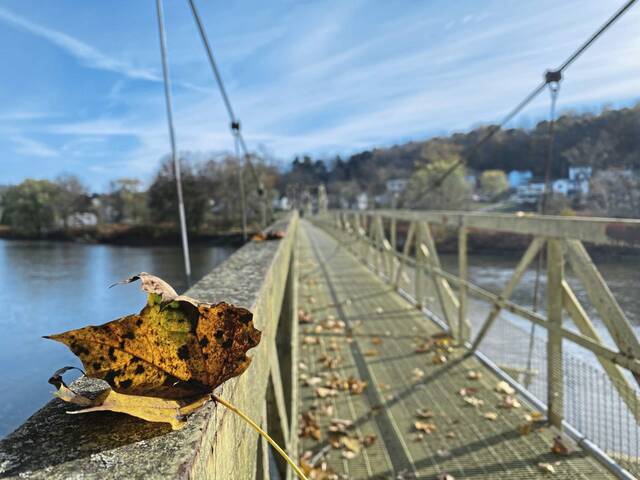
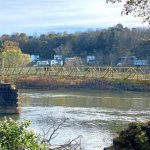
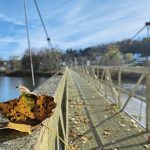
The pale yellow metal pedestrian bridge spans the Kiski River and connects Leechburg and Hyde Park and their two counties — Westmoreland and Armstrong. Owned by both counties, the bridge is officially named Armstrong County Bridge No. 13, spanning 600 feet in length and standing 40 feet above the water.
“I wondered what it was. My neighbor told me about it,” said Johnston, 26. “I didn’t know it was so historic either, until I did some research.”
Johnston, who doesn’t own a vehicle, said she relies on the bridge to travel to Leechburg for groceries and other shopping needs. “I walk it several times a month, and I like when it sways,” she said.
The pedestrian bridge opened in 1920. But its history stretches back to its birth as a railroad bridge in 1886.
That bridge didn’t last long — it was a casualty of the 1889 Johnstown flood, which wiped out many structures downstream. The bridge was reconstructed , but other flooding issues caused the railway to abandon it in 1904. A ferry service was established instead.
A horrific ferry accident in Hyde Park killed eight people in 1913. In response, a wooden pedestrian bridge was constructed on the heavy stone pillars of the original structure. That 1920 bridge was revamped in 1937, and replaced by the current metal bridge in 1955.
Its 600-foot length consists of three spans. The open grate walkway width is a little over 4 feet and provides views of the river below.
Like any suspension bridge, it sways and moves in response to the foot traffic and weather conditions.
“I like being on it when it’s windy,” Johnston said.
Leechburg resident and local historian Larry Boehm said he fields lots of questions from the public about the unusual structure.
He said the 1920 bridge served as a necessary link between Leechburg and Hyde Park and provided the first alternative to crossing the river after the Hyde Park ferry closed.
Boehm, president of the Leechburg Area Museum and Historical Society, said back then lots of people coming home late at night from local bars were killed by trains.
“Before the construction of the bridge, residents from Hyde Park would travel to Leechburg by ferry or by walking the railroad tracks for services such as banking, shopping,” he said. ”Many Leechburg residents made the trip over to Hyde Park to wet their whistle at their bars, as Leechburg was a dry town.”
Boehm called the 1913 tragedy ferry accident instrumental in the decision to build a safer way to cross the river — hence the foot bridge.
“Lots of people still use the foot bridge for recreational purposes like running and cycling,” Boehm said. “It’s also just a cool spot to just hang out and take in views of the river.”