More than 1,100 people experienced homelessness in Allegheny County on a single night this year, according to newly released county data that used a revised counting method intended to produce a more accurate estimate of the region’s unhoused population.
The Allegheny County Department of Human Services announced results from its new effort to measure homelessness on Monday. Sheltered homelessness stabilized in 2026 after five consecutive years of increases in the annual count, officials said.
Community Counts is a new approach to the department’s previous annual “Point-in-Time” count. The count is conducted nationwide on a single night each January to provide a snapshot of homelessness and to determine federal housing funding, as mandated by the U.S. Department of Housing and Urban Development.
In 2026, the county launched the new volunteer-driven approach to the unsheltered estimate. The new methodology emphasizes geographic coverage using statistically valid sampling and can be replicated to allow for more accurate year-over-year trends.
“Our goal is to steward a system where no one in Allegheny County is ever forced to sleep outside due to lack of shelter capacity,” said Alex Jutca, acting DHS director in a news release. “We will build on our progress by investing in housing and behavioral health interventions that help people stabilize and recover.”
Jutca could not be reached for immediate comment on Monday.
On the night of Feb. 3, 270 volunteers counted individuals in emergency shelters, short-term housing programs and those living unsheltered in places not meant for human habitation.
The count found that 84% of Allegheny County’s estimated homeless population on the night of the count was in shelter rather than staying outside.
Allegheny County Councilwoman at-large Bethany Hallam joined volunteers for the count in Pittsburgh’s South Side neighborhood.
Hallam, who also chairs the county’s housing and homelessness committee, said she thinks the time of year of the mandated survey creates a semi misleading impression because more people seek shelter during cold weather.
On the night of the survey, the county saw temperatures at a low of 12 degrees, according to National Weather Service meteorologists.
“It was freezing,” Hallam said. “I don’t think it gives a super clear picture of what the homeless population is experiencing.”
Hallam said that along the river between South Side Works shopping center and Station Square, volunteers saw three unhoused people. Hallam said she believes there would have been more people had temperatures been warmer.
Last January results showed a significant increase of 66% in the homelessness in the county. The high numbers prompted county officials to conduct a recount in March.
The recount revealed slightly lower numbers than what was reported in January 2025, with more than 1,000 people in the county experiencing homelessness, including 886 in emergency shelters and 244 unsheltered
The new counting methodology was modeled after similar programs in New York and Paris. Volunteers found 930 people were in shelters and 178 were unsheltered.
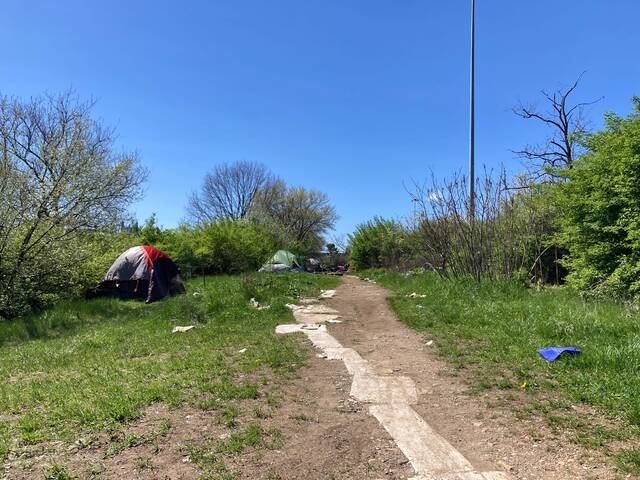
This year’s study reported that unsheltered adults were found in the same concentrated areas as previous years, specifically in the South Side, South Hilltop, Homewood, the Central Business District and North Side. Most people were sleeping in abandoned houses or buildings and tents or temporary shelters.
“Twenty percent of those counted as unsheltered had an unknown sleeping location as they were not yet bedded down when surveyors observed or attempted to interview them,” the report said.
Hallam attributed the county’s first stabilized results to efforts from County Executive Sara Innamorato, such as the 500 in 500 initiative, rather than a change in methodology.
The 500 in 500 initiative, which was launched in June 2024 to help people out of homelessness by making 500 affordable housing units available in Allegheny County in 500 days.
“I’m pleased with the progress we’re seeing in moving unhoused neighbors from outside to shelter and from shelter to homes,” Innamorato said in a news release. “Reliable data can help us make informed decisions about the best way to deploy resources and help our neighbors in need.”