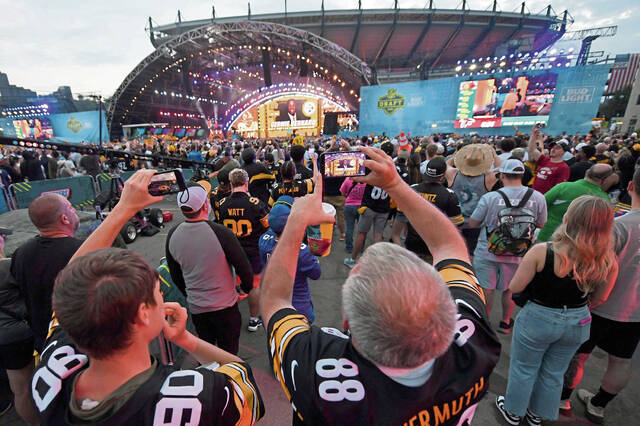
The 2026 NFL Draft drew about 805,000 people in Pittsburgh last week, according to the NFL — but that’s likely not the most staggering number linked to the three-day event.
City officials are still calculating how much the city spent to play host to the league’s largest off-season event, but initial estimates put the figure around at least $3 million.
The city is unlikely to fully recoup that cost.
The outlay includes about $2 million tied to overtime costs. Public safety and public works personnel were deployed in droves to close roads, monitor crowds, care for fans and clean up litter.
Plus, the city gave local tourism agency Visit Pittsburgh $1 million in taxpayer dollars to support the event.
“There is no financial boon for the city of Pittsburgh here,” Councilman Anthony Coghill, D-Beechview, said during a City Council meeting last week. “If we have our expenses covered at the end, that’s great.”
Council on Tuesday voted to accept a $2 million reimbursement from Pennsylvania, which was routed through Visit Pittsburgh. Officials hope that will cover the cost of overtime.
Even if it does, “we’re still negative a million dollars,” Councilwoman Deb Gross, D-Highland Park, pointed out last week.
Asked by council whether the city would see $1 million in additional revenue from the draft to break even, Finance Director Jen Gula responded, “I don’t honestly think so.”
“That’s distressing,” Gross replied.
Rea Price, acting director of the Office of Management and Budget, last week told council that early estimates put overtime costs around $1.8 million.
Molly Onufer, a spokeswoman for Mayor Corey O’Connor, on Tuesday told TribLive she did not yet have an estimate of how much the city spent to host the draft. She did not know when that information might be available.
Pennsylvania chipped in $10 million to support the event. Allegheny County provided $3 million from hotel tax revenue.
The city is unlikely to see any windfall from hosting the draft. Revenues from sales tax and hotel tax, for example, don’t directly flow to the city but instead support the state and county.
Gula last week predicted the city’s parking tax could see a bump because some garages and lots were jacking up prices, though she acknowledged it “might be a wash” since other lots were forced to close to accommodate the event.
Over the course of the three-day spectacle, several lots lowered their rates as more people opted to use public transit than navigate a maze of road closures and pricey parking.
Visit Pittsburgh estimated the draft would generate an economic impact in the range of $120 to $213 million — though that doesn’t necessarily mean the city or nearby businesses will see a surge of revenue.
In prior host cities, various factors contributed to the massive economic impact figures trumpeted by the NFL.
Economic impact numbers can include all spending at businesses and hotels near the draft footprint, as well as indirect spending like businesses buying more food or the NFL hiring subcontractors to erect a stage for the event.
Businesses outside of the event footprint told TribLive they weren’t seeing the extra customers they’d hoped to welcome during the draft. Other host cities have also seen businesses outside of the event struggle to lure fans away from the action.