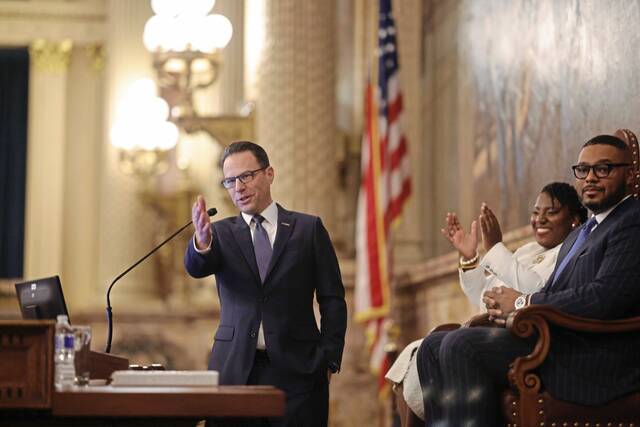

Pennsylvania Gov. Josh Shapiro has proposed, and the state House has passed, a measure to raise the Keystone State’s minimum wage to $15 an hour to begin 2029. But a researcher at the Allegheny Institute for Public Policy says the detriments of such an increase (if adopted by the state Senate and signed into law by the governor) would outweigh the purported benefits.
“At best, increasing the minimum wage to $15 — even if over time — will be an unnecessary price floor that will benefit some workers at the expense of others and impose higher costs on some businesses at the expense of others,” says Alex Sodini, a research associate at the Pittsburgh think tank.
“At worst,” he says, “it is a state mandate to force firms to pay above-market wages, likely raising prices for Pennsylvanians, displacing entry-level workers and hurting businesses, especially smaller ones.”
The measure would raise the minimum wage to $11 per hour in 2027, $13 per hour in 2028 and $15 per hour in 2029, effective Jan.1 of each year. Beginning Jan. 1, 2030, and each year thereafter, it then would then be subject to an annual cost-of-living adjustment.
But an analysis by the state’s Independent Fiscal Office found that “the proposal would modestly reduce non-tipped employment (-16,000 jobs) and raise income for directly affected low-income workers (684,000) largely due to an income transfer from higher-income consumers and certain business owners to lower-income workers.”
“By that logic,” Sodini says, “increasing the minimum wage is no more than a progressive wealth redistribution scheme wrapped in sheep’s clothing.”
That same 2025 IFO analysis of a $15 hourly minimum assumes that “60(%) of the wage increase is passed on to resident consumers through higher prices.” A reduction in profits and non-wage compensation (20%), efficiency gains (10%) and non-residents through exports or tourism (10%) would make up for the remaining 40%, the IFO says.
Sodini reminds that all hourly workers earning below the minimum wage would immediately receive a jump in pay.
But, “Keep in mind that entry-level and low-wage employees having their wages boosted will also put upward pressure on wages for those earning at or modestly above $15 per hour.”
Citing a previous policy brief, “(e)mployees who have put in the time and have the knowledge and experience to currently earn $15 per hour will not sit still to see their experience and knowledge be devalued,” he recounts.
Firms in four particular sectors — food prep and service, personal care, health care support and building and grounds maintenance — would likely be subject to significant increases in the cost of labor which would likely be passed on, in part, through higher prices to all consumers, the think tank researcher says.
“Those firms which cannot successfully pass on, or absorb the costs, will be forced to reduce employee hours, lay off workers, reduce non-wage compensation or close altogether — likely to the detriment of some of the very workers a minimum wage increase is supposed to help,” Sodini stresses.
The governor says a $15 minimum wage would “generate economic activity, increase the purchasing power of Pennsylvania residents and add more than $80 million annually in increased revenue” to state coffers while decreasing “the cost of entitlement programs … (resulting) in over $300 million in total savings… .”
But Sodini says the claim is riddled with caveats.
“First, increasing the cost of labor and placing a higher burden on businesses while contributing to unemployment must be considered against any meaningful gains in economic activity,” he says. “Likewise, the purchasing power of Pennsylvania residents is unlikely to rise significantly if businesses must increase prices to absorb the costs imposed by raising the minimum wage.”
Meanwhile, Sodini reminds that the claim of $80 million annually in increased revenue is based on an increase in net revenue due to higher personal income tax and sales and use-tax collections offset by corporate net income tax collections — a result of employers claiming higher payroll taxes as a deduction.
“As Policy Brief Vol. 26, No. 11, noted, doubling down on anti-business measures to raise revenue for state coffers is poor public policy,” he says.
Another caveat is the higher wage floor’s impact on entitlement programs. While moving enough residents beyond the income threshold for certain benefits would result in a fall in total claimants, “it’s important to remember that workers who see reduced hours, are laid off or cannot find work may become qualified for new or additional benefits such as Unemployment Compensation or Medicaid, which will increase the cost of those programs,” Sodini says.
If the governor and Legislature wish to help workers in Pennsylvania, raising the minimum wage is the wrong prescription, Sodini says.
“To sustainably increase wages and employment opportunities, elected officials should be looking to alleviate the burden on businesses imposed by the state’s regulatory and tax climate instead of adding to it.
“Likewise, it would be far more sensible to enact policies which encourage businesses to relocate and invest in Pennsylvania — without relying on corporate handouts and targeted subsidies and incentives,” Sodini concludes.