There always have been elected officials whose appeal defies their demographics.
Former U.S. Sen. Joe Manchin spent years as the token Democrat in deep-red West Virginia. Democrat Camille “Bud” George was the godfather of Central Pennsylvania politics for decades despite swimming in a sea of Republican constituents.
Pennsylvania knows this kind of political crossover well.
But that kind of appeal doesn’t usually raise questions about identity. It simply reflects a politician who can win over voters outside their party.
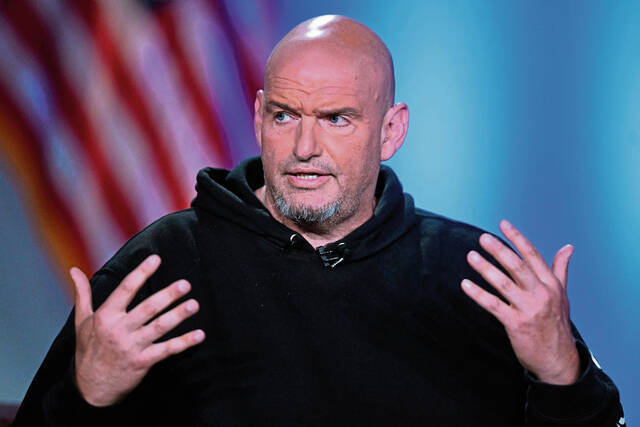
What’s happening now with John Fetterman is something else.
The senior senator from Pennsylvania has long been a politician who resisted the rules of behavior and conformity. If his height and stature don’t set him apart, his preferred uniform of hoodies and shorts does. He can be pugnacious in pressing a point.
When his political career started as mayor of Braddock, party seemed immaterial. He was an outside-the-box figure, someone who seemed to stand apart from party as much as from politics.
That has been, for many, part of Fetterman’s political charm. As his profile grew statewide, so did that appeal. He has at times been more popular with the broader electorate than within his own party.
In 2018, he walked to a 17-point win over Republican Jeff Bartos for lieutenant governor — a wider margin than the 14-point lead he held over the runner-up in the Democratic primary.
But that has changed in recent years.
Fetterman’s stroke in 2022, just before the primary election, didn’t stop him from trouncing his fellow Democrats. But it did keep him off the campaign trail and led to hospitalization for post-stroke depression shortly after he took office in 2023.
There has been a clear shift in some positions that has distanced him from Democratic colleagues, especially on Israel and immigration. This has created significant problems for Fetterman with Democrats in polling.
A Quinnipiac poll in March showed a 108-point swing in his approval among Democrats. While he is 40 points underwater with his own party, 73% of Republicans now approve of his performance.
Will this matter for reelection in two years?
It might.
That’s where Pennsylvania Republican Party Chairman Greg Rothman comes in. He told The Center Square that he would consider supporting Fetterman — if he were to switch parties — based on what he described as agreement on key issues, even while acknowledging broad disagreement elsewhere. It’s an argument that turns traditional political math on its head, suggesting the right 20% can outweigh the other 80%.
It raises a question: Is Fetterman a Democrat because that’s how he sees himself, or a Republican because that’s who seems to like him more?
Identity politics is usually framed as a voter problem. But it applies to politicians, too.
No one has the right to tell Fetterman who he is. That’s something he gets to decide for himself. But by the same token, it’s up to the parties to decide where they throw their support — and to the electorate to decide who gets the votes.