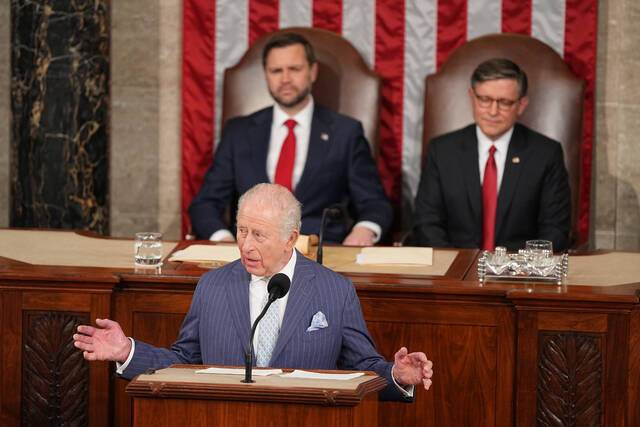
King Charles III did not arrive in Washington this week with a fully armed battalion to remind Americans of his love. He did, however, show up with some cheeky side-eye and what passes for clever quips from a 77-year-old British grandpa.
There is often chatter about the “special relationship” between the United States and the United Kingdom.
We are bonded by language and history — both of which have changed with time.
Since declaring independence, 45 men have served as president of the United States. Power has swung between political parties.
Meanwhile, the British have kept it in the family. George III was King Charles III’s fourth great-grandfather.
The differences are clear.
Our palaces are not supposed to be about personal aggrandizement or opulent shows of wealth. They are not as old or as steeped in history as Windsor Castle or the Tower of London — and that’s by design. King Charles III leaned into that reality as he noted the nation’s anniversary.
“That’s 250 years, or as we say in the United Kingdom, just the other day,” Charles said.
It’s a long way from the promise in “Hamilton” that “You’ll Be Back.”
In a constitutional monarchy, the king does not rule. He nods while others do. King Charles III is expected to understand his government — and then step aside so it can run.
That isn’t what Americans wanted after the war. The Founding Fathers did not want a king. They did want a say in how the government ran.
As King Charles III returns in this landmark year, it raises a simple question: How well is that working?
We didn’t want to be what George III called “sweet, submissive subjects” in “Hamilton.” We wanted participation. We did not want power concentrated in the hands of the wealthiest, handed down like royal jewels.
That was the promise.
Today, we are uncomfortably close to oligarchy, with billionaires bankrolling our politics. We have 43 members of Congress, as well as the president, who are older than the king.
“George Washington’s yielding his power and stepping away?” marveled George III in “Hamilton.” “I wasn’t aware that was something a person could do.”
Most lawmakers don’t seem to realize that either.
The actions of George Washington that so surprised George III were not written into the Constitution. They began a tradition of bowing out and stepping aside. That would be just as foreign to King Charles III, who had to wait for his mother’s death at 96 to take the throne.
A lot has changed in those 250 years.
“Indeed, the very principle on which your Congress was founded — no taxation without representation — was at once a fundamental disagreement between us, and at the same time a shared democratic value which you inherited from us,” Charles said.
The king is reminding us of our democratic values. That’s something Alexander Hamilton could never have seen coming.