
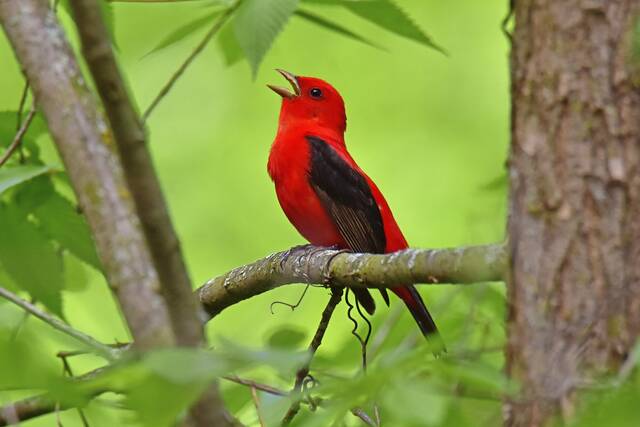
Taking a morning walk through Beechwood Farms or one of the Pittsburgh region’s many wooded green spaces, you may catch a flash of brilliant red in the treetops. At first glance, you might assume it’s a northern cardinal. But it’s spring migration in Pennsylvania, so take a closer look.
It could instead be a scarlet tanager, a vividly colored migratory songbird that lives in Pennsylvania’s hardwood forests during the spring and summer. In fact, Pennsylvania hosts more breeding scarlet tanagers than any other state, making the commonwealth one of the bird’s most important breeding grounds in the country and the entire hemisphere.
There’s a reason for this. Pennsylvania is home to extensive tracts of mature hardwood forests that are important for both people and tanagers. That’s one of the reasons the scarlet tanager is considered an “indicator species.”
Where they thrive, we know that a forest is healthy. Where they decline, it can indicate forest fragmentation, invasive species or broader ecological stress that affects wildlife and people alike. Protecting the tanager means conserving and managing the forests and habitats that Pennsylvania’s communities rely on for clean air, economic opportunities, recreation and natural beauty.
Through public awareness and responsible forest management, Pennsylvanians have the opportunity to protect both forest health and the wildlife that depends on it.
That effort is gaining momentum in Harrisburg. I have introduced legislation that would designate the scarlet tanager as Pennsylvania’s official migratory bird. The designation highlights the state as a premier destination for birding, outdoor recreation, and forest conservation through active management. And it’s already gaining bipartisan support. It was developed in collaboration with the Audubon Society of Western Pennsylvania and the National Audubon Society, which collectively represent over 56,500 Audubon members in Pennsylvania who advocate for the conservation of birds and the places they rely on for survival.
Importantly, the proposal brings attention to the value of healthy forests and bipartisan conservation efforts. Protecting bird habitat, preserving biodiversity and supporting sustainable forestry practices are goals that benefit all Pennsylvanians, regardless of political affiliation. The designation celebrates Pennsylvania’s rich biodiversity and would inspire future generations to take an active role in environmental stewardship and conservation.
Conservation work is already producing measurable results. At the Audubon Society of Western Pennsylvania, existing programs conserve 500 acres of forest. Individuals and families participate in over 1,000 environmental education programs each year, and tens of thousands of people visit the four publicly accessible nature reserves, providing close contact with the birds and habitat that tell the story of the Three Rivers region. Programs are focused on conservation, education and storytelling that connect people to birds and the places they rely on.
Partnerships like these with the National Audubon Society and the state Legislature provide an opportunity to tell more of the tanager’s story.
The scarlet tanager is more than a beautiful bird of Western Pennsylvania’s forests. It is a symbol of Pennsylvania’s rich natural heritage and a reminder of the responsibility we share to protect it. By supporting conservation initiatives and the effort to designate the scarlet tanager, lawmakers can help ensure this vibrant songbird remains a welcome sight for generations to come.
The Pennsylvania Legislature has the opportunity to pass House Bill 2316 this spring, just as tanagers begin to build nests and hatch chicks across the state. Passing the bill would send a strong bipartisan message about Pennsylvania’s unique connection to the natural world, and all of the wonders that birds bring to the people and places of our state.
Learn more from Audubon Mid-Atlantic.
State Rep. Mandy Steele represents the 33rd Legislative District in Allegheny County.